Vitamin D for Pressure Sore Healing: What the Evidence Says

Table of Contents
Why I Started Looking Into Vitamin D for Pressure Sore Healing
What Vitamin D Actually Does in the Body
Immune function and normal cellular processes
Vitamin D Deficiency and Wound Healing: Association, Not Proof
Does Supplementation Actually Help Pressure Sores Heal?
Why diabetic foot ulcer evidence does not transfer directly
Vitamin D Deficiency vs Taking More Vitamin D
Nutritional Support for Pressure Ulcers: Where Vitamin D Fits
What I Would Ask My Healthcare Team About Vitamin D
Conclusion
Frequently Asked Questions
Last Updated: 28 September 2026
Why I Started Looking Into Vitamin D for Pressure Sore Healing
Vitamin D for pressure sore healing became a subject I looked into properly after months of slow progress, not because anyone told me it was the answer. I'm not a doctor. I'm the patient. This article combines published information with lessons from my own experience of living with serious pressure sores. It is intended to help you understand the subject and ask better questions of your healthcare team, not replace professional medical advice. (Source: a 2021 systematic review)
What nobody explained to me early on was how many separate things have to line up before a wound closes. Pressure and shear have to be managed. Infection has to be controlled. Nutrition has to be adequate. Vitamin D sits inside that last category, and it is a subject that often gets misunderstood. Below, I'll separate what is established, what is association, and what is genuinely uncertain, because those three things get mixed together constantly.
What Vitamin D Actually Does in the Body
Vitamin D is a fat-soluble nutrient that the body uses to regulate calcium and phosphate absorption, support bone health, and contribute to normal immune function. That much is established.
Immune function and normal cellular processes
The immune system depends on vitamin D for normal function. Immune cells carry the receptor that vitamin D binds to, and the nutrient plays a part in how those cells mature and respond. Skin cells also respond to vitamin D signalling, which is one reason researchers became interested in wound repair.
Here is the trap. A nutrient having a biological role in a process does not mean that giving more of it speeds that process up. Vitamin C is essential for collagen formation, but that biological role alone doesn't mean taking more than you need will necessarily make a wound heal faster. Vitamin D deserves the same scrutiny.
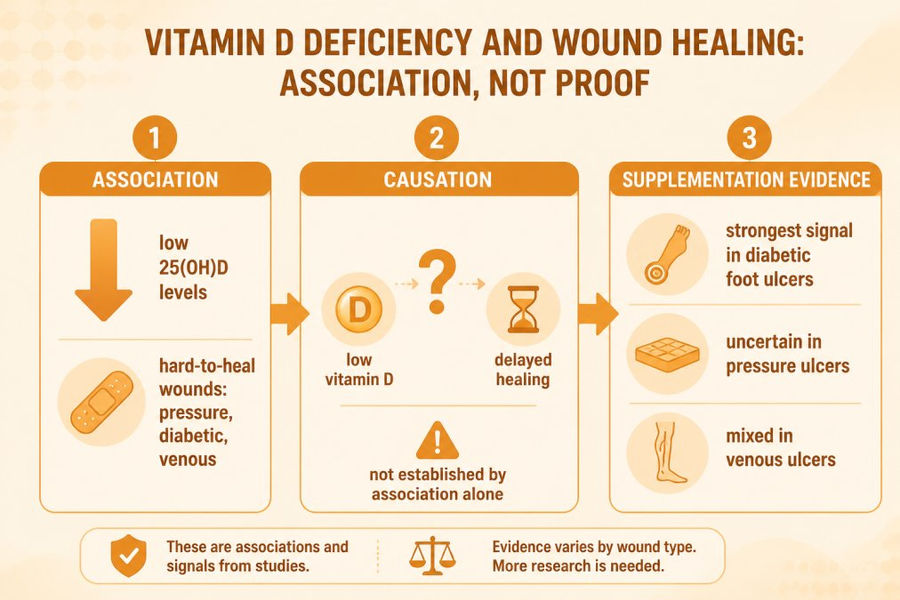
Vitamin D Deficiency and Wound Healing: Association, Not Proof
Low vitamin D levels are found more often in people with hard-to-heal wounds, but that finding does not prove low vitamin D caused the wound or delayed healing. This is the single most important distinction in this whole subject.
A 2021 systematic review covering pressure ulcers, diabetic foot ulcers and venous leg ulcers analysed 10 studies with 2,359 participants and found a strong correlation between low 25-hydroxyvitamin D levels and these wounds (Checking your browser). The authors stated it remained unclear whether this relationship was causal or correlational, and so should we be. Low vitamin D could contribute to poor healing. Poor healing could also lead to low vitamin D, because unwell people spend less time outdoors and eat less well. Or a third factor, such as chronic illness or older age, could drive both.
Does Supplementation Actually Help Pressure Sores Heal?
No trial has yet shown that giving vitamin D to people with pressure ulcers speeds up healing. That is the honest position, and it matters more than any encouraging headline.
Why diabetic foot ulcer evidence does not transfer directly
Several randomised controlled trials and meta-analyses have reported encouraging effects on some diabetic foot ulcer healing outcomes when vitamin D was given. That evidence has real limitations: trial size, quality and the specific outcomes measured all vary. It is also not about you if you have a pressure sore.
Diabetic foot ulcers sit in a different patient group, with different blood supply, different biomechanics and a different underlying disease. A pressure ulcer is caused by sustained pressure and shear over a bony prominence. Different wound, different population, different cause. Treating one body of evidence as proof for the other is how people end up taking high doses for no reason.
Watch Out Do not start high-dose vitamin D on your own to try to heal a pressure sore. Excessive supplementation can cause hypercalcaemia, raised blood calcium, which in turn can damage the kidneys. This is a real risk with unsupervised high doses.
Vitamin D Deficiency vs Taking More Vitamin D
Correcting a confirmed deficiency and assuming that more vitamin D heals faster are two completely different things. Current pressure-ulcer guidance supports correcting confirmed or suspected vitamin or mineral deficiencies as part of overall care. It does not support giving extra vitamin D to people who already have enough.
The specific contribution of individual micronutrients to pressure-ulcer healing remains uncertain. Nutrition matters, but it does not heal a pressure sore on its own. Energy, protein, hydration and overall nutritional status all matter, and none of them can compensate for continued pressure or shear. (Source: the National Institutes of Health Office of Dietary Supplements)
If you are deficient, correcting that is reasonable and usually clinician-guided. If your levels are normal, more is not better.
Nutritional Support for Pressure Ulcers: Where Vitamin D Fits
Nutritional support for pressure ulcers is a whole-diet question, not a single-supplement question. Vitamin D is one part of it, alongside adequate energy, protein and fluids.
Think of it in layers:
First: enough energy and protein to rebuild tissue. Without these, nothing else works.
Second: enough fluid to support circulation and tissue perfusion.
Third: correcting any confirmed deficiencies, including vitamin D, iron or others identified on testing.
Fourth: managing pressure, shear, infection and circulation, because no nutrient fixes those.
Vitamin D is a supporting player in that list. It is not the headline act, and anyone selling it as one is overselling.
Pro Tip Ask whether your vitamin D level has actually been measured, rather than assuming you need a supplement because pressure sores are slow to heal. A blood test turns a guess into a decision.
What I Would Ask My Healthcare Team About Vitamin D
Questions I would ask now, having gone through this, are specific and short. Bring them to your wound-care team or GP.
Is vitamin D testing appropriate for me, given my wound and my general health?
If I am tested, what does my 25(OH)D result actually mean, and where does it sit against the reference range?
If I am deficient, how will it be corrected, at what dose, and for how long?
When should my level be rechecked to confirm the correction has worked?
Are there other nutrients or factors in my case that matter more right now?
You are an important member of your own wound-care team. Asking these questions is not second-guessing anyone. It is doing your part.
Conclusion
Vitamin D for pressure sore healing is a subject where the biology is real, the association is real, and the proof of benefit is not yet there for pressure ulcers specifically. Correcting a confirmed deficiency is sensible. Assuming higher doses heal faster is not, and it carries real risks.
Pressure Sore Recovery exists to help you hold both halves of that picture at once: respect the evidence, and ask better questions.
If you want the fuller picture, the 24-chapter guide Pressure Sore Recovery: What Nobody Told Me covers nutrition, protein, wound healing, infection, surgery and prevention in plain English.
BUY THE PDF - £9.99
The hardest part of a long recovery is not the wound itself. It is the fog of not knowing which questions to ask. Pressure Sore Recovery was built from almost six years of living with serious pressure sores, and it covers the practical ground most people are left to work out alone: nutrition and protein for tissue rebuilding, understanding infection and osteomyelitis, preparing for and recovering from flap surgery, and protecting vulnerable skin afterwards. If you want a clear, patient-written companion to use alongside your wound-care team, get started with Pressure Sore Recovery and walk into your next appointment better prepared.
Frequently Asked Questions
Does vitamin D help pressure sores heal faster?
The honest answer is that we do not know for certain. Research shows people with hard-to-heal wounds often have lower vitamin D levels, but this association does not prove that low vitamin D caused the wound or slowed healing. Some trials in diabetic foot ulcers suggest supplementation may help, but those are different wounds and different patient groups. Current pressure-ulcer guidance supports correcting confirmed deficiencies, while the specific contribution of individual micronutrients remains uncertain. If you suspect a deficiency, ask your wound-care team about testing rather than self-supplementing.
Is there a link between vitamin D deficiency and pressure ulcers?
Studies have found that low vitamin D levels are more common in people with chronic, hard-to-heal wounds, including pressure ulcers. A 2021 systematic review covering pressure, diabetic and venous ulcers noted this association. However, association is not the same as causation. It is possible that poor nutritional status, limited sun exposure, immobility or underlying illness contribute to both low vitamin D and slower healing. The link is worth discussing with your healthcare team, but it does not mean vitamin D deficiency is the sole cause of your pressure sore.
Should I take vitamin D supplements for a pressure sore?
Do not start high-dose vitamin D on your own. If you have a confirmed or suspected deficiency, your clinician may recommend supplementation at a specific dose and arrange follow-up testing. Taking more than you need does not speed up healing and can cause harm, including hypercalcaemia and kidney problems. Current guidance for pressure ulcers supports correcting deficiencies, but it does not recommend routine high-dose vitamin D for wound healing. Ask your GP or wound-care team whether testing is appropriate for you before starting anything.
Can too much vitamin D be harmful?
Yes. Vitamin D is fat-soluble, so excess amounts are stored in the body rather than flushed out in urine. Very high intakes over time can cause hypercalcaemia (too much calcium in the blood), which may lead to nausea, confusion, kidney stones and, in severe cases, kidney damage. This is why high-dose vitamin D should only be taken under medical supervision with appropriate monitoring. If you are considering supplements, speak to your GP or wound-care team about safe dosing and whether testing is needed first.
BUY THE PDF – £9.99


Comments