5 Skin Barrier Options for Wheelchair Users: What to Know

Table of Contents
Why Skin Barrier Products Matter When You Use a Wheelchair
Quick Comparison: Five Barrier Product Types at a Glance
Zinc Oxide Creams: Thick, Protective and Hard to Remove
Dimethicone Creams: Breathable Barriers for Everyday Wheelchair Skin Protection
Petrolatum-Based Ointments: Occlusive Protection and Their Limits
Polymer Barrier Films: A Barrier Film for Fragile Skin
Barrier Sprays and Wipes: Practical Use and Where They Fit
Moisture-Associated Skin Damage: Why It Is Not a Pressure Injury
What I Would Ask My Wound Nurse Before Choosing
Frequently Asked Questions
Last Updated: 16 October 2026
Why Skin Barrier Products Matter When You Use a Wheelchair
I'm Not a Doctor, I'm a Patient
If you search for the 5 best skin barrier creams for wheelchair users, you will find plenty of lists. What you will not find is a straight answer about what these products actually do, and what they cannot do. This guide from Pressure Sore Recovery covers the five main barrier product types, their real strengths and limits, and the questions worth asking before you buy anything.
I'm not a doctor. I'm the patient. This article combines published information with lessons from my own experience of living with serious pressure sores. It is intended to help you understand the subject and ask better questions of your healthcare team, not replace professional medical advice.
Here is the point most lists skip: a barrier product protects skin from moisture and irritants. It does not redistribute pressure. It does not treat a pressure injury. If pressure and shear are not being managed, no cream on the market will compensate.
That distinction matters more than any brand comparison.
Quick Comparison: Five Barrier Product Types at a Glance
The five main barrier types differ in form, how long they last, and whether they interfere with dressings. The table below summarises the practical differences.
Product type | Form | Typical use area | Wash-off needed | Dressing/adhesive compatibility | Main limitation |
Zinc oxide cream | Thick cream or paste | Perineum, skin folds, incontinence-prone skin | Yes, often difficult | Can reduce adhesive grip | Hard to remove; may clog dressings |
Dimethicone cream | Light cream or lotion | Everyday protection on intact skin | No, absorbs | Generally compatible | Less occlusive; needs frequent reapplication |
Petrolatum ointment | Ointment | Dry, intact, vulnerable skin | Yes | Can loosen tapes and films | Occlusive; traps moisture if skin is already wet |
Polymer barrier film | Liquid film, wipe or spray | Fragile or broken-adjacent skin | No, wears off | Usually compatible with dressings | Stings on broken skin; technique matters |
Barrier spray or wipe | Aerosol or pre-soaked wipe | Large or awkward areas | No | Varies by product | Less control over coverage; easy to miss areas |
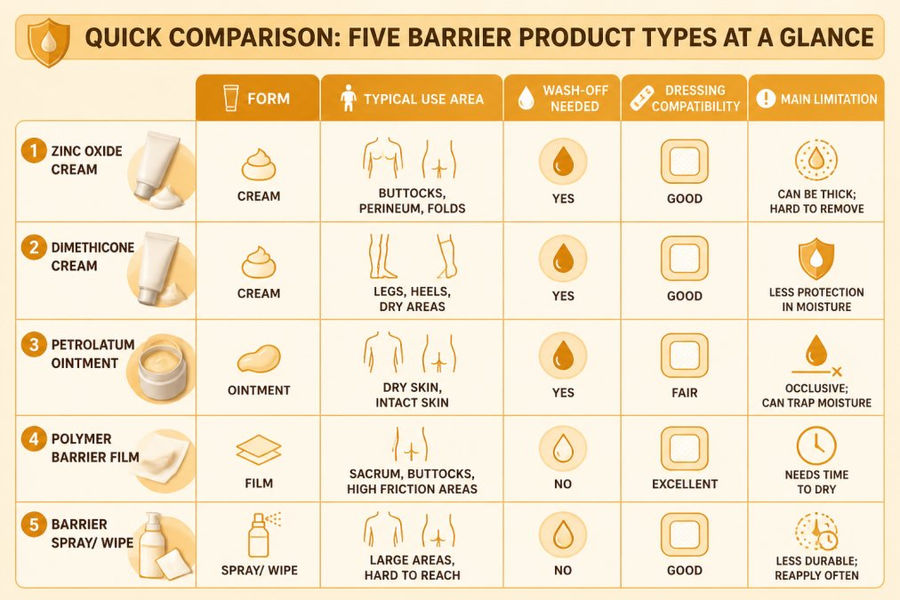
Not all five are creams. Two of them are films and sprays. That matters if you have been told to "use a barrier cream" and then handed a wipe.
Zinc Oxide Creams: Thick, Protective and Hard to Remove
Zinc oxide creams are the classic barrier. They sit on the skin as a physical layer, blocking moisture and irritants. For incontinence-associated skin, they are one of the most familiar options.
The advantages are real:
Strong moisture barrier
Useful in skin folds and the perineal area
Long-lasting once applied
The drawbacks are just as real. Zinc oxide is difficult to remove, and aggressive washing to get it off can damage skin further. It can also interfere with adhesive dressings, which is a problem if you have a wound dressing nearby.
Watch Out Never scrub zinc oxide off fragile skin. Repeated harsh washing to remove a barrier cream can strip the skin and create the very breakdown you were trying to prevent. Ask your wound nurse which removal method suits your skin.
Dimethicone Creams: Breathable Barriers for Everyday Wheelchair Skin Protection
Dimethicone creams are lighter. They form a breathable film that protects intact skin from moisture and friction without the heaviness of zinc oxide.
For wheelchair skin protection, dimethicone suits everyday use on skin that is intact but vulnerable. It absorbs rather than sitting on the surface, so it is less likely to interfere with dressings or adhesives.
The trade-off is durability. Dimethicone wears off faster and needs more frequent reapplication, especially with sweating or incontinence. It is a good default for intact skin. It is not the right choice for skin that is already broken.
Petrolatum-Based Ointments: Occlusive Protection and Their Limits
Petrolatum ointments seal the skin. They are highly occlusive, which makes them useful on dry, intact, vulnerable skin.
Their limitation is the flip side of their strength. If skin is already wet from sweat or exudate, an occlusive ointment traps that moisture against the skin. That can worsen moisture-associated skin damage rather than help it.
Petrolatum can also loosen tapes and film dressings. If you have a dressing in place, check with your wound nurse before applying anything nearby.
Polymer Barrier Films: A Barrier Film for Fragile Skin
A barrier film for fragile skin is a liquid that dries into a thin, protective layer. It is applied as a wipe or spray and wears off on its own, so there is no scrubbing to remove it. (Source: NHS guidance on preventing pressure ulcers)
This is where barrier films earn their place. When skin is fragile, thin or at risk of breaking down, avoiding friction from washing and removal matters. Films are also generally compatible with dressings, which makes them useful around wound sites.
Two honest caveats. First, many films sting on broken skin. Second, technique matters: the film needs to dry fully before anything touches it, or it will not perform as intended.
Barrier Sprays and Wipes: Practical Use and Where They Fit
Sprays and pre-soaked wipes are the convenience option. They cover large or awkward areas quickly, which helps if you or your carer are managing skin in a chair or in bed.
The limitation is control. Spray coverage is uneven, and it is easy to miss a patch. Wipes can also dry out if the packaging is not sealed properly.
Where they fit best is routine, large-area application on intact skin, not precision work around a wound. For that, a film wipe or a cream gives you more control.
If you want the fuller picture of how moisture damage, pressure and shear interact, our guide to moisture-associated skin damage explains the difference in detail. If you are working on prevention more broadly, our article on wheelchair skin protection covers daily routines, and our piece on preventing recurrence looks at what happens after a sore has healed.
Moisture-Associated Skin Damage: Why It Is Not a Pressure Injury
Moisture-associated skin damage and pressure injury are different problems, and confusing them leads to the wrong product.
Moisture-associated skin damage is skin breakdown caused by prolonged contact with moisture such as urine, faeces, sweat or wound exudate (pubmed.ncbi.nlm.nih.gov). A pressure injury is damage caused by sustained pressure and shear, usually over a bony prominence.
They can occur together, and one can make the other worse. But the fix is different. Moisture damage needs the moisture source managed and the skin protected. A pressure injury needs pressure redistribution and offloading, alongside wound care.
Barrier products help with the first. They do nothing for the second. This is the single most important thing I wish I had understood earlier.
Key Takeaway A barrier cream protects skin from moisture and irritants. It cannot replace pressure redistribution or treat a pressure injury. If pressure and shear are not being managed, no barrier product will fix the problem.
What I Would Ask My Wound Nurse Before Choosing
Before buying anything, I would ask these questions. They are the ones that changed my choices.
Is my skin intact, or is there already breakdown?
Is the problem moisture, pressure, friction, or a combination?
Will this product interfere with my dressings or adhesives?
How often should it be reapplied, and who should apply it?
How should it be removed without damaging my skin?
Does it need to be avoided near a wound or in a skin fold?
Should this be part of a wider pressure-relief plan?
Any broken skin, spreading redness, warmth, swelling or feeling generally unwell needs clinical review, not a new cream. Suspected infection is a conversation with your wound-care team, not a self-treatment decision.
If you want to go further into the questions, products and practical lessons from almost six years of living with serious pressure sores, Pressure Sore Recovery: What Nobody Told Me is a 24-chapter instant-download PDF.
BUY THE PDF - £9.99
Choosing a barrier product is not about finding the "best" one. It is about matching the product type to your skin, your moisture problem and your dressings, while keeping pressure redistribution and shear management central. That is a conversation worth having with your wound-care team, and it is one you can lead.
At Pressure Sore Recovery, we built our resource around what I learned the hard way: that patients who understand their own skin become better partners in their care. Our 24-chapter PDF covers pressure and shear, wound healing, infection, surgery and long-term prevention in plain language, written from the patient's side of the bed.
Get started with Pressure Sore Recovery and ask better questions at your next appointment.
Frequently Asked Questions
What is the best barrier cream for wheelchair users?
There is no single best skin barrier product, because the right choice depends on why your skin is at risk. Zinc oxide suits heavy incontinence exposure, dimethicone suits everyday moisture and friction, petrolatum ointments stay put but can be greasy, polymer barrier films dry without residue and are useful for fragile skin, and sprays or wipes help with awkward areas. The product type matters less than matching it to the problem and asking your wound nurse, especially if skin is already broken.
Can barrier cream prevent pressure sores?
No. Barrier products protect skin from moisture and irritants, which are separate risks, but they cannot replace pressure redistribution or offloading. A pressure injury develops when pressure and shear reduce blood flow to tissue, and no cream changes that. If you are sitting for long periods, the priorities remain regular pressure relief, a suitable cushion and skin inspection. Barrier products work alongside those measures, not instead of them.
What is the difference between moisture damage and a pressure injury?
Moisture-associated skin damage comes from prolonged contact with urine, faeces, sweat or wound exudate, and it often appears as redness or irritation in skin folds or under pads. A pressure injury results from pressure and shear reducing blood flow, and it typically develops over bony prominences. The two can look similar early on, and they can occur together. If you are unsure which you are dealing with, or the skin is broken, ask your wound nurse rather than guessing.
Can barrier creams affect wound dressings or adhesive products?
Yes, and this is one of the most common practical problems. Zinc oxide and petrolatum-based products leave a residue that can stop dressings, tapes and adhesive devices from sticking. If you have a dressing near the area you want to protect, tell your wound nurse which product you plan to use and where. Some barrier films are designed to sit under adhesives, but this depends on the product and the dressing, so check before applying anything close to a wound.
BUY THE PDF – £9.99

Comments