Is Surgical Debridement Worth the Recovery Time? A Patient's Guide

Table of Contents
What Surgical Debridement of a Pressure Sore Actually Involves
How It Differs from Routine Wound Care and Other Debridement Methods
Why Clinicians Recommend Removing Dead or Infected Tissue
Debridement vs Flap Surgery: Two Different Operations, Two Different Recoveries
Pressure Sore Debridement Risks, Pain and Anaesthesia: What I Wish I Had Known
What Does Recovery Actually Involve?
Wound Management, Pressure Redistribution, Nutrition and Rehabilitation
Is It Worth It? Questions to Ask Before Pressure Sore Surgery
Conclusion: Weighing the Recovery Time Against the Alternative
Frequently Asked Questions
Last Updated: 16 October 2026
I'm Not a Doctor, I'm the Patient.
What Surgical Debridement of a Pressure Sore Actually Involves
Surgical debridement is the removal of dead, damaged or infected tissue from a wound using surgical instruments, usually under anaesthesia in an operating theatre. It is not the same as cleaning a wound on a district nurse's visit. (Source: NHS guidance on pressure ulcers)
I'm not a doctor. I'm the patient. This article combines published information with lessons from my own experience of living with serious pressure sores. It is intended to help you understand the subject and ask better questions of your healthcare team, not replace professional medical advice.
The question in the title, is surgical debridement worth the recovery time, is one I have sat with myself. The honest answer is that it depends on what is in the wound, what your general health is like, and what the alternative looks like.
NHS guidance on pressure ulcers describes debridement as a core part of wound bed preparation when dead tissue is present (NHS pressure ulcer treatment guidance). NICE also covers wound debridement in its guidance on chronic wounds (NICE guidance on chronic wounds).
The surgeon removes the tissue that is stopping the wound from moving forward. What is left behind is a clean base that has a chance to heal, or a wound that is ready for reconstruction later.
How It Differs from Routine Wound Care and Other Debridement Methods
Routine wound care means cleaning, dressing and protecting the wound. Debridement goes further. It actively removes tissue.
Surgical debridement: sharp instruments, theatre, anaesthesia. Fastest method, removes the most tissue.
Conservative sharp debridement: small amounts of dead tissue removed by a trained nurse at the bedside.
Autolytic debridement: dressings that keep the wound moist so the body's own enzymes soften dead tissue. Slow but gentle.
Enzymatic debridement: topical agents that break down dead tissue. Used in some centres, not all.
Larval therapy: sterile maggots that eat dead tissue. Still used in some NHS settings.
Which method you are offered depends on the wound, the centre and the clinician. Protocols vary. There is no single universal approach.
Why Clinicians Recommend Removing Dead or Infected Tissue
Dead tissue in a wound is a problem for three reasons. It feeds bacteria, it blocks the wound from closing, and it hides how deep the wound really is.
Slough and necrotic tissue give bacteria somewhere to grow. They also stop new tissue forming across the wound bed. Until that tissue is removed, the wound often stalls.
Watch Out A wound with spreading redness, foul smell, new pain or a fever needs urgent professional assessment. Do not try to manage suspected infection at home. Significant infection can worsen quickly, and in some cases deeper structures such as bone may be involved.
This is where osteomyelitis enters the picture. A pressure sore that is deep, longstanding or repeatedly infected raises the risk of bone involvement, but depth alone does not confirm it. Only imaging and, in some cases, a bone biopsy can establish that. I've written separately about [osteomyelitis from pressure sores] and what the investigation process actually involves.
Removing infected tissue does not guarantee healing. It gives the wound a better chance. That is the honest way to frame it.
Debridement vs Flap Surgery: Two Different Operations, Two Different Recoveries
Debridement and flap surgery are often mentioned in the same conversation, and that confuses people. They are not the same operation, and the recovery is not the same either.
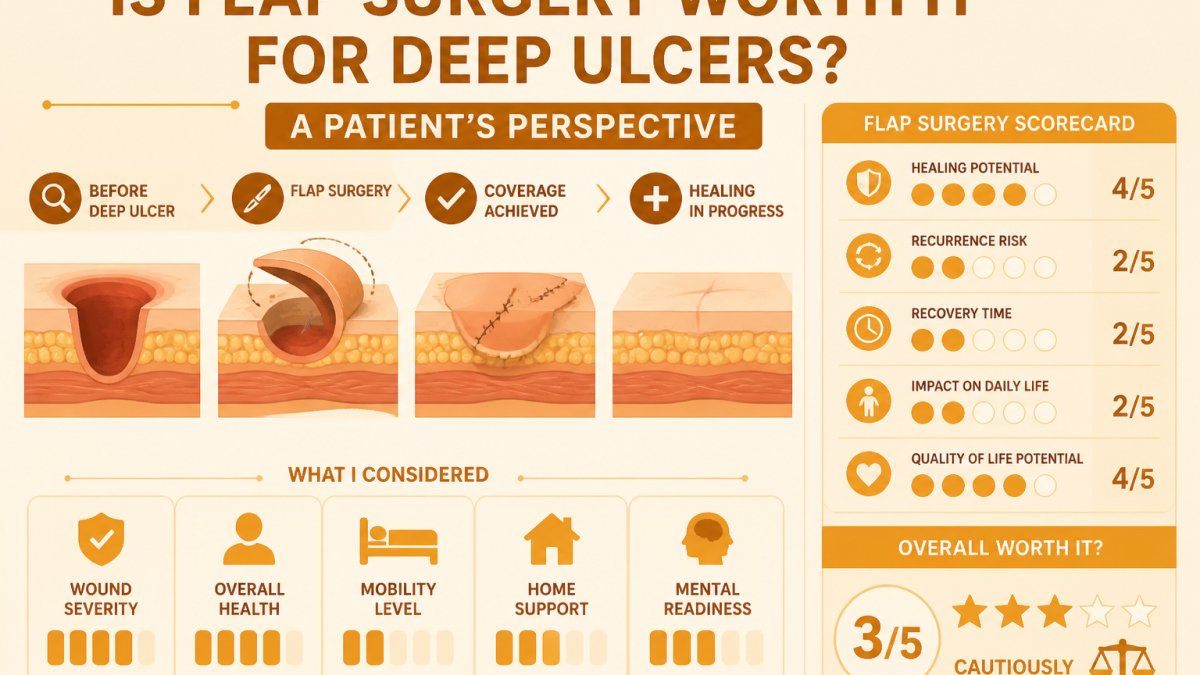
Debridement clears the wound. Flap surgery reconstructs it. A flap procedure moves healthy tissue, often muscle or skin with its blood supply, over the wound to close it.

Feature | Surgical Debridement | Flap Surgery |
What it does | Removes dead or infected tissue | Reconstructs the wound with healthy tissue |
Wound after | Open, left to heal or prepare | Closed with a flap |
Anaesthesia | Usually general or regional | General |
Typical recovery focus | Wound bed, infection control | Flap survival, no pressure on the site |
Further surgery | Sometimes needed | Sometimes needed |
I've written a fuller piece on [flap surgery recovery] if that is the operation you are facing. The two are often planned together: debridement first to clean the wound, flap surgery later once the wound bed is ready.
Pressure Sore Debridement Risks, Pain and Anaesthesia: What I Wish I Had Known
Nobody sat me down and listed the risks in plain language. Here is what I would want to know now.
Bleeding. Debridement cuts into tissue, and some bleeding is expected. In a wound near major vessels, or in someone on blood-thinning medication, bleeding can be more significant. Your team will assess this beforehand.
Pain and anaesthesia. Surgical debridement is usually done under general or regional anaesthesia, so you should not feel the procedure itself. Afterwards, the wound can be sore. Pain relief should be discussed before, not after. (Source: NICE guidance on chronic wounds)
Infection. Removing infected tissue can improve a wound, but surgery also creates a new wound. There is a risk of infection afterwards. This is why wound care and monitoring matter so much in the days that follow.
Repeat procedures. One debridement is not always enough. Dead tissue can reaccumulate, and infection can return. Some people need more than one procedure. This is not a failure on anyone's part. It reflects how stubborn pressure sores can be.
Undermining and depth. Debridement can reveal that a wound is deeper or more undermined than it looked on the surface. That changes the plan.
Pro Tip Ask your surgeon before the operation what the plan is if the wound turns out to be deeper than expected. Knowing the answer in advance makes the recovery conversation much easier.
What Does Recovery Actually Involve?
Recovery from surgical debridement varies enormously. There is no universal timeline, and anyone who gives you one is guessing.
It depends on wound depth and size, whether infection was present, your circulation, your nutrition, your other health conditions, and whether further reconstruction such as a flap is planned.
Wound Management, Pressure Redistribution, Nutrition and Rehabilitation
Wound management. Expect regular dressing changes, often by a district nurse or in a wound clinic. The wound may be packed. It may be cleaned with specific products. Follow the plan your team gives you.
Pressure redistribution. This is not optional. A dressing cannot compensate for continued pressure or shear on the same area. Offloading means not lying or sitting on the wound. That may mean a specific mattress, a repositioning schedule, or time off the area entirely. I've written about [wound healing and pressure relief] in more detail.
Nutrition. Energy, protein and hydration support tissue repair. Nutrition alone does not heal a pressure sore, and no supplement replaces offloading. If you are unsure whether your intake is adequate, ask for a dietitian review.
Rehabilitation. Depending on your situation, this may involve physiotherapy, gradual return to sitting, and a plan for how to protect the area long term.
A carer's role here matters, and so do boundaries. Carers can help with repositioning, meals, dressing changes and noticing changes. They cannot and should not be expected to make clinical decisions alone. If something looks worse, that is a call to the wound-care team.
BUY THE PDF - £9.99, Pressure Sore Recovery: What Nobody Told Me covers the practical side of wound care, nutrition and surgery recovery in 24 chapters.
Is It Worth It? Questions to Ask Before Pressure Sore Surgery
This is the section I would read first if I were you. The decision belongs with you and your surgical team, and you are allowed to ask hard questions.
Key Takeaway Surgical debridement is not always necessary, and it does not guarantee healing. It is one option among several, and the right choice depends on your wound, your health and your goals.
Questions I would ask my surgeon now:
What is the goal of this debridement: infection control, wound bed preparation, or both?
What happens if we do not operate, and what is the likely course?
What are the specific risks for me, given my health and medications?
Will I need more than one procedure?
What does aftercare look like, and who will provide it?
How will this affect my independence in the weeks after?
Is flap surgery likely to be needed later, and how does that change the plan?
Write the answers down. Take someone with you if you can. It is easy to forget half of what is said once you are back on the ward.
Conclusion: Weighing the Recovery Time Against the Alternative
The recovery time after surgical debridement is real, and it is not something to brush past. There is theatre, anaesthesia, wound care afterwards, offloading, and often a long stretch of being careful.
But the alternative also has a cost. A wound full of dead or infected tissue can stall for months, and in some cases it worsens.
The challenge is that nobody can tell you in advance exactly how your recovery will go. What you can do is go into the conversation informed, with the right questions written down. That is what Pressure Sore Recovery is for: a patient-led resource based on almost six years of living with serious pressure sores, built to help you understand wound healing, infection, surgery and recovery in plain language. Our 24-chapter guide, Pressure Sore Recovery: What Nobody Told Me, covers the practical detail I wish someone had handed me at the start. Get started with Pressure Sore Recovery and walk into your next appointment knowing what to ask.
Frequently Asked Questions
What is surgical debridement for a pressure sore?
Surgical debridement is an operation to remove dead, damaged or infected tissue from a pressure sore so the wound has a cleaner base to heal from. It is different from routine dressing changes and from flap surgery, which reconstructs the wound with new tissue. Whether it is right for you depends on the wound's depth, how much non-viable tissue is present, whether infection is suspected, and your overall health. Your wound-care team can explain what they are proposing and why.
How is surgical debridement different from flap surgery?
Debridement clears away tissue that is dead or infected, while flap surgery moves healthy tissue over the wound to close it. The two are sometimes used together: debridement may come first to prepare the wound, with flap reconstruction considered later if needed. Recovery differs too, because flap surgery usually involves stricter protection of the repaired area afterwards. Ask your surgeon which approach they are recommending, and whether one may follow the other.
What are the risks of pressure sore debridement, and does it hurt?
Risks can include bleeding, infection, pain, and the possibility that further debridement or reconstruction is needed later. Anaesthesia is usually used, so the procedure itself should not be painful, but discomfort afterwards is common and should be discussed with your team. If you notice spreading redness, fever, or worsening pain, seek professional assessment rather than managing it yourself. Your surgeon can talk you through the specific risks for your wound and general health.
What questions should I ask before pressure sore surgery?
Ask what the operation aims to achieve, what alternatives exist, what the risks are for you specifically, and what aftercare and pressure redistribution will be needed. It also helps to ask how surgery may affect your independence, and what could happen if it is delayed. Write the questions down and take someone with you if you can. You are an important member of your own wound-care team, and clear answers help you take part in the decision.
BUY THE PDF – £9.99

Comments